Showing posts with label philosophy. Show all posts

Saturday, October 13, 2007

Extended Mind Thesis

I touched on the idea of the extended mind over a year ago, when I wrote "love, pizza, grief, and personal identity. At the time, I had not heard the idea named, and did not know that the extended mind thesis is a well-developed and hot topic in cognitive science and philosophy of mind. I find it fascinating:

From Wikipedia:
The Extended Mind refers to an emerging concept within the philosophy of mind that addresses the question as to the division point between the mind and the environment by promoting the view of active externalism. This view proposes that some objects in the external environment are utilized by the mind in such a way that the objects can be seen as extensions of the mind itself. Specifically, the mind is seen to encompass every level of the cognitive process, which will often include the use of environmental aids.

The primary body of work in the field is The Extended Mind, by Andy Clark and David Chalmers. In this paper, Clark and Chalmers present the idea of active externalism, (similar to semantic or "content" externalism,) in which objects within the environment function as a part of the mind. They argue that it is arbitrary to say that the mind is contained only within the boundaries of the skull. The separation between the mind, the body, and the environment is seen as an unprincipled distinction. Because external objects play a significant role in aiding cognitive processes, the mind and the environment act as a "coupled system.” This coupled system can be seen as a complete cognitive system of its own. In this manner, the mind is extended into the external world. The main criterion that Clark and Chalmers outline for approaching the use of external environmental objects utilized during cognitive tasks as a part of an extended cognitive system is that the external objects must function with the same purpose as the internal processes.

In The Extended Mind, a thought experiment is presented to further illustrate the environment's role in connection to the mind. The fictional characters Otto and Inga are both travelling to a museum simultaneously. Otto has Alzheimer’s Disease, and has written all of his instructions down on in a notebook to serve the function of his memory. Inga is able to recall the internal instructions within her memory. In a traditional sense, Inga can be thought to have had a belief as to the location of the museum before consulting her memory. In the same manner, Otto can be said to have held a belief of the location of the museum before consulting his notebook. The argument is that the only difference existing in these two cases is that Inga's memory is being internally processed by the brain, while Otto's memory is being served by the notebook. In other words, Otto's mind has been extended to include the notebook as the source of his memory.
From "Collective memory, group minds, and the extended mind thesis" abstract
While memory is conceptualized predominantly as an individual capacity in the cognitive and biological sciences, the social sciences have most commonly construed memory as a collective phenomenon. Collective memory has been put to diverse uses, ranging from accounts of nationalism in history and political science to views of ritualization and commemoration in anthropology and sociology. These appeals to collective memory share the idea that memory “goes beyond the individual” but often run together quite different claims in spelling out that idea.


I should note for any interested readers that in philosophy, the words "internalism" and "externalism" can mean different things depending on the subject matter. For instance, when discussing theories of knowledge, internalism and externalism refer to different kinds of theories regarding epistemic justification (e.g., reliable process v. coherence or mental states).

In this instance, externalism refers to the idea that a part of the mind or memory is located outside of the brain. I am quite at ease with this notion, and I feel that it is almost certainly true, although there are quite a lot of details to be worked out.


Questions (idle, amateurish ones all):

Is the extended mind idea plausible? Is the idea compatible with other well-supported theories of how the mind works?

If the extended mind exists, is it the case that it makes real - that is, enables the existence of - group minds, analogous to individual minds that actually think and react to stimuli? Or, is the extended mind merely an ability of the individual mind to store, retrieve, and/or process information externally, using the environment?

Does this inform theories of group consciousness and group memory? I am sceptical of both, but it seems to me that if extended consciousness is demonstrated, then perhaps it could be a mechanism for the functioning of some kind of group consciousness or shared memory.

How does this impact our notions of community, morality and personal moral responsibility?

Since I had not heard of the extended mind when I first started writing about it, is it the case that I absorbed the idea from some sort of group consciousness, made possible by the extended mind?

Related topics: innatism/nativism, memetics.

Sunday, October 07, 2007

Monty Python's philosopher's drinking song


Immanuel Kant was a real pissant
Who was very rarely stable.

Heidegger, Heidegger was a boozy beggar
Who could think you under the table.

David Hume could out-consume
Wilhelm Friedrich Hegel, [some versions have 'Schopenhauer and Hegel']

And Wittgenstein was a beery swine
Who was just as schloshed as Schlegel.

There's nothing Nietzsche couldn't teach ya
'Bout the raising of the wrist.
Socrates, himself, was permanently pissed.

John Stuart Mill, of his own free will,
On half a pint of shandy was particularly ill.

Plato, they say, could stick it away--
Half a crate of whisky every day.

Aristotle, Aristotle was a bugger for the bottle.
Hobbes was fond of his dram,

And René Descartes was a drunken fart.
'I drink, therefore I am.'

Yes, Socrates, himself, is particularly missed,
A lovely little thinker,
But a bugger when he's pissed.

Saturday, July 22, 2006

Snaars Collegiate Philosophy Dictionary, part 1

Culled from various non-copyrighted sources on the internet, with some modifications here and there by yours truly ...

  • Abnormal: <Ambrose Bierce> not conforming to standard. In matters of thought and conduct, to be independent is to be abnormal, therefore detested.

  • Abstract logic: 1 see definition two 2 see definition one. See also Recursive

  • Accountability: the mother of caution

  • Anarchy: such a good idea, it should be the law

  • Annoying: two people who go right on talking after you’ve interrupted

  • A Priori: we’ll just assume I am right

  • A Posteriori: having seen who won, I can assure you I was on that side the whole time

  • Analytic: occurring once yearly

  • Bachelor: a man who Mrs. nothing

  • Education - 1 <Ambrose Bierce> that which discloses to the wise and disguises from the foolish their lack of understanding 2 [Politics] proof positive that government can do some things more economically than private enterprise 3 <B. F. Skinner> what survives when what has been learned has been forgotten

  • Fallacy: why even you don’t know why you’re wrong

  • False consciousness: deep down, you know I’m right

  • Income: you try to make it first, then you try to make it last

  • Recursive: Referring back to itself. See recursive. See also Abstract Logic

  • Syntax: money collected at church

  • Synthetic: I am so not-right that I can’t be wrong

  • Time: 1 an illusion perpetrated by the makers of space 2 a way of preventing everything from happening simultaneously

  • Truth: the actual state of things, insofar as they conform to what seems self-evident to me

  • University: a modern post-secondary school where football is taught

Thursday, July 20, 2006

To Thine Own Self Be True

This above all: to thine own self be true,
And it must follow, as the night the day,
Thou canst not then be false to any man.
- William Shakespeare

Saturday, May 13, 2006

The mind/body connection and the soul - do they exist?

I am enjoying the interchange begun in my previous post, but the conversation is going far afield of the original topic and the thread is getting long, so I am offering everyone the opportunity to continue the discussion here.

Cyberkitten said:

I am gradually coming to the conclusion that the 'mind' as a separate entity doesn't actually exist - hence there is no "mind-brain" connection.

I didn't mean to imply that the mind has any sort of existence apart from the brain. But, the mind is not just the brain. At the very least, it is the activity that occurs in the brain.

The brain produces the 'mind' as part of the way it functions. Yes, this is more like what I mean. The mind is a product, and like any product it can be distinguished from that which produces it. When the computer is off, the software can't run.

I can think of three reasons to think that the mind is not synonymous with the brain:

First, there is something about the nature of experience which leads me to the conclusion that the mind is distinguishable from the brain.

The best way for me to explain is to use an illustration.

Think of an elephant. Imagine the big ears, the greyish, leathery skin, the prehensile trunk, etc. - imagine the most detailed elephant you can. Now, you are having what might be called an elephant-like experience in your mind.

Presumably, there is some activity occuring in your brain that corresponds to the elephant-like experience. But the activity in your brain is not experienced by you. Your experience is something HUGE, smelly, rough, hairy in some places, capable of making a trumpet-like sound. There is nothing in your physical brain that has those qualities. There's just tissue, swimming in hormones and electrolytic fluids, sparkling with electrical activity.

Secondly, I can consider in my mind things that cannot exist physically - the elements of Euclidean geometry, for instance. Points, lines, and planes cannot exist in physical space, hence they cannot exist in the brain - but I can contemplate them in my mind.

Thirdly, a brain can exist without a mind, such as when it is unconscious or dead. If the mind were just the brain alone, that wouldn't be possible.

The evidence that brain activity corresponds to our experience is so strong as to be nearly absolutely certain. Eventually, we will learn to stimulate or program the brain directly, to produce an experience in the mind. But brain activity, on the one hand, and the experience itself, on the other hand, are qualitatively different.

I think a few more words about the soul are in order, considering what was said in the last post. The term "soul", in my opinon, is a loose, general way of talking about things that we feel are essential to who we are. Perhaps it is true that there is no single, unchangeable thing that defines a person - but it doesn't follow that we have no essential qualities or characteristics.

There are activities, personality traits, values, interests, plans, and relationships I have, that make me unique and that help to define me. Any of those elements may change with experiences I have, or decisions I make. Over time, if enough of those changes occur, then I may look back at my history and say to myself, "I'm really not the same person I was." And that's okay - I don't believe any contradiction is involved - because the sense of "same" we are talking about involves NOT a mere physical continuity, but that set of characteristics that we feel makes us who we are. So, I think that even our souls are subject to change.

Tuesday, May 09, 2006

love, pizza, grief, and personal identity

Love is not one single emotion. When I say "I love pizza," I'm not saying the same thing as when I say "I love my Michelle."

How does one begin to describe a thing that means so much?

I once had a conversation with a fellow philosophy student - David, in fact. A recurring theme of our philosophic discussions has been the problem of personal identity. The issue is a complex one. In some sense, everyone who reads this today is "the same" person as when they were born. And yet, adults are not the same as children - there are many differences - so we're not the same as when we were born. How can we be - today - the same as when we were born, yet not the same as when we were born? For that matter, how can we be the same and yet not the same person as we were yesterday?

There are several very good explanations of this, and of other problems of personal identity - but I haven't read one that was entirely satisfactory.

At any rate, I expressed the opinion to David that any theory of personal identity ought to account for feelings of grief. At the time, he thought it quite odd that I should say this. "But," I said, "how can you explain that a person feels like a part of themselves has been taken away when a loved one dies? Isn't it likely that a feeling of drastic change within one's self - subjective though that feeling might be - doesn't it give us some insight into what personal identity is?"

Anyone who has personally felt, or heard vividly described, the sense of personal loss and emptiness that accompanies the death of a loved one, will appreciate what I mean. It seems reasonable that a theory of personal identity should be able to "handle" such feelings - someone's sense that they have become different, in general; and the sense of having become different as a result of losing a loved one, specifically.

We know that certain functions and capabilities of the brain - preprocessing, perception, memory, the ability to reason, motor control - are somewhat independant, being centered in distinct areas. Perhaps what we experience as consciousness is, in part, the communication that takes place between these structures within the brain.

It could be analogous to a conversation that takes place between semi-distinct yet interdependant parts. In a mentally healthy individual, it may be more like a ballet, wherein all the parts have learned to perform in coordination and with alacrity. In contrast, one who experiences cognitive dissonance may be depressed or unusually tired mentally.

So, what causes this feeling of personal change when we lose a loved one?

When we love someone deeply, we feel a kind of familiarity. We depend on that other person to provide input much like we depend on the various cognitive structures that make up our own selves. When we lose that, realizing that we won't be getting it back, we get a sense of emptiness. All the dancers can carry out their moves in concert - but the presentation is lacking, and some aspects are impossible, because a dancer is missing.

Michelle is capable of seeing things I cannot see. She understands things that I don't understand - until she explains them to me. Things that need to be done, she does when I don't have time, or the necessary inclination or imagination. She is capable of interacting with some people on a level I cannot reach.

Michelle can hold me - I can't hold myself! She can laugh at my jokes - I can't laugh at them myself! (Well, I can sometimes, but it's not nearly the same.) We made a family together - certainly couldn't have done that by myself!

Here's to you, my Michelle. You are actually my better half.

Sunday, March 26, 2006

scientism

"Scientism" is an irrational belief that only that which can be observed and measured through the technique of "Scientific Method" is real, and everything else is unreal. It has become a popular epithet among creationists, who have latched on to the term and use it as a prejorative, designed to cast doubt indiscriminately on conclusions drawn by the scientific method - and "scientistic" is a term designating those who have confidence in said conclusions.

I performed a google search on the words "scientistic evolution" and found this web site, self-proclaimed as the "only site on the web devoted exclusively to intellectual conservatism". (Apparently it's "intellectually conservative" to attack a distorted and over-simplified view of science and rationality, and to dismiss hundreds of years of valid, rational, scientific progress as mere "scientism". I offer the link merely as an example of anti-science rhetoric that is readily available and gaining widespread acceptance today.)

Can no one see the difference between science and scientism? Scientism is an irrational belief in the conclusions of science. Those who study the methods of science, understand that science is based on rationality, and therefore (provisionally) accept the conclusions of science as being the best possible ones are not scientistic, because we are being completely and utterly rational. People who do not understand the rules of good reasoning, including the rational basis for science, and who accept scientific conclusions on the basis of faith, these are the scientistic ones.

Creationists want to portray scientists, philosophers, and all others who understand and accept good principles of scientific reasoning as being scientistic materialists. They do this in order to present science and religion as being on equal footing, both matters of "blind faith". Nothing could be further from the truth.

It is completely rational to believe and understand that there are limits to what science can tell us, while accepting the perfectly valid and reasonable conclusions that science has to offer.

That's my opinion, briefly stated. What's yours?

Thursday, March 16, 2006

Come, fellow believers.

Brother, sister, enter in. Self-consciousness is but a stumbling block. Snaarsconsciousness is the key. Do but this: devote yourself to the snaars, and all else will be revealed as dreamstuffs.

Friday, January 20, 2006

The "Joe's Special Shrapnel" Example

Joe is innocently walking down the street minding his own business when a gas main in the basement of a nearby apartment complex explodes. Joe gets a cut on his head. Joe believes his injuries are minor and doesn't realize that he has a small piece of shrapnel lodged in his brain. At first, Joe has only mild physical symptoms and he does not connect them to the head injury.

Over the next year Joe's symptoms worsen. He experiences sudden mood swings, dizziness, nausea, insomnia, paranoia, and hallucinations. Joe sees a doctor but the doctor fails to diagnose the problem, which is a piece of shrapnel lodged in Joe's brain.

Joe begins to see the world differently. Eventually he flies into an unprovoked rage and beats his wife Jane, whom he loves and to whom he has been married for years, to death.

In the process of struggling with his wife Joe sustains another head injury. Joe is arrested and taken to a hospital where x-rays reveal the shrapnel embedded in Joe's skull. This type of injury is known to cause the symptoms that Joe experienced. Joe’s doctors believe that the shrapnel may be life-threatening. The shrapnel is removed and Joe recovers from his brain injuries. His symptoms subside, and his personality returns to "normal" (at least, as normal as could be expected given recent traumatic events).

Joe and his wife were happy before Joe's initial head injury, and investigators can uncover no other motive for the murder, because in fact no motive exists. Based on the evidence and the testimony of Joe’s doctors, Joe is acquitted of all charges. Joe goes on to have a long life and never hurts another human being. He is active, productive at work, and has a lot of close friends. He mourns the loss of his wife always.

Are you, the reader of the story, justified in hating Joe? Is anyone justified in hating Joe? Is Joe really responsible for the death of his wife Jane? If so, why? If not, then what killed Jane – a piece of shrapnel? An exploding gas main?

Where is “free will” in all of this? Could Joe have done otherwise than what he did? Should he have gone to see more doctors before he killed Jane? Should Jane have insisted on it?

What about personal identity? Who is the “real” Joe – Shrapnel Joe, who killed his wife, or Normal Joe, who regretted the loss of his wife?

If Shrapnel Joe had a full understanding of his situation, and refused the personality-altering surgery, would the doctors have been morally justified in compelling him to undergo the procedure? Why or why not?

In Joe’s case, the cause of his errant behavior was identifiable. Certainly, not all murder cases are like Joe’s. But what if they were? What if all murders could be understood as well, and all people could be treated as easily as Joe was treated?

Suppose human behavior was so well-understood that you could walk into a clinic, have a few simple tests and a harmless brain scan, and therapists could analyze the information and share with you profound insights into your life and personality. They could help you stay mentally alert and emotionally balanced. If there was a dangerous personality disorder, they could offer prescriptions and referrals to specialists who could help.

Your personality could be adjusted through the use of counseling, exercise, diet, sensory stimuli (such as viewing images), drugs, and surgery. In criminal cases, people might even be legally obligated to undergo such personality adjustments. Would you still be "you" after undergoing many of these adjustments?

Is the above scenario really possible? Why or why not?

Saturday, January 14, 2006

sufficient reason for conversation

All right snaars fans, I've let you dangle far too long. After all, I am not a sadistic monster. Your ardor for me may be undeserved but it is not anappreciated, I assure you.

One of the few regular commentators recently sent me an e-mail to express his nostalgia for the good ol' days when we used to discuss philosophy and religion on this blog. I would like to begin breaking the extensive silence by indulging my Humean hobby, my Socratic skill, my Platonic profession, my cosmological craft, my Voltarian vocation.

No, it's not alliteration - it's Aristotelian argumentation! It's philosophy. Of religion. You know - Maimonic meditation!

No tricks, and nothing hidden up my sleeve. I'm working without notes, without a textbook (all my books are still in storage), and without a safety net. Er, I did use the internet as a resource, but that's it. This is completely raw philosophy of the most amateurish variety.

I offer up for your consideration the Principle of Sufficient Reason - henceforth referred to as PSR.

PSR has been expressed and implied countless times throughout history, particularly in philosophical writings. Perhaps the earliest and most-quoted is that of Parmenides, who said: 'Ex nihilo nihil fit,' which means 'From nothing, nothing comes.'

'Nothing happens in vain, but everything for a reason and under necessitation,” claimed Leucippus (Who, incidentally, posited the existence of atoms approximately eleven hundred years before the invention of the microscope, and thirteen hundred years before John Dalton discovered the Law of Multiple Proportions.)

“Everything, then, which is such that its act of existing is other than its nature must needs have its act of existing from something else,” wrote St. Thomas in the De Ente et Essentia.

Gottfried Wilhelm Leibniz, (who invented calculus), wrote:
Our reasonings are founded on two great principles, that of Contradiction …. And that of Sufficient Reason, in virtue of which we consider that no fact can be real or actual, and no proposition true, without there being a sufficient reason for its being so and not otherwise, although most often these reasons cannot at all be known by us.
Rogers and Hammerstein wrote "Nothing comes from nothing/Nothing ever could/So somewhere in my youth or childhood/I must have done something good."

Er, Rogers and Hammerstein weren't philosophers in any sort of formal sense.

But I love The Sound of Music. So there.

PSR is integral to various versions of the Cosmological Argument for the existence of God. Essentially, most of them go something like this:
  1. Everything has a cause.
  2. Nothing can cause itself.
  3. Everything is caused by another thing.
  4. A causal chain cannot be of infinite length.
  5. There must be a first cause.
  6. God was the first cause.
Okay, I got the above argument from wikipedia, and it seems to me that this formulation is inherently contradictory. If everything must have a cause, then how can there be a first cause? Why can't a causal chain be infinite - is there a reason? To fix the argument, 2 should probably read, 'Nothing except God can cause itself', or something like that - but then the argument would commit the fallacy of begging the question.

I'm sure I've seen better versions. Despite it's problems, the argument above illustrates the importance of PSR in philosophy. Other arguments attempted to use PSR to refute God's existence, btw.

PSR has intuitive appeal. I believe that the philosophers cited above accepted PSR as a given. They didn't spend a lot of time deliberating over it or defending it. It just seemed true to them. Is it really true?

Our day-to-day experience seems to support PSR. Whatever happens, we believe there's a reason, don't we? If my car starts making a knocking sound, and I bring it to a mechanic, and the mechanic tells me that there's no reason for the knocking sound, then guess what? I'm going to another mechanic! I can easily believe that a mechanic could not know what causes a knocking sound, but I can't easily believe that the sound has no cause whatsoever.

Why, PSR seems almost fundamental to our sense of curiosity and the scientific and philosophical enterprise! Why should we go around looking for the causes of things, if we're not sure that things necessarily have causes?

Then again, why should we think that "no fact can be real or actual, and no proposition true, without there being a sufficient reason for its being so and not otherwise"? That's a strong statement! How can anyone possibly know that? There's a lot more to this universe than our own hum-drum day-to-day activities, isn't there? What about the ultimate origins of the universe? Did the universe even have an ultimate origin? Is an origin necessary?

Whether we can know the answer or not, surely there is a truth to the matter of whether the universe had a beginning.

If there was an origin, does it require "sufficient reason?" But that would mean that there was something before the universe ... Does that which came before the universe require "sufficient reason," or would that thing carry its "reason" within itself, somehow? Many theologians believe that God is such a being. The fact that PSR is considered in connection with God is a testament to the power of philosophy.

Is there any reason to think that there could be a case in which PSR does not hold? I can think of one, which is our seeming free-will. PSR smacks of determinism, doesn't it? If everything necessarily has a sufficient cause, then all of my actions have a sufficient cause, and so do yours! How do we reconcile PSR with our notions that we could have done something other than we did?

I don't have an opinion one way or another regarding the validity of PSR right now. The purpose of this post is not to take a stand one way or the other, but to introduce the concept to a general audience.

Philosophy is not any particular doctrine. It is a method of inquiry. There are philosophers who believe in a god, and there are philosophers who do not. Both perform mental gymnastics in pusuit of the truth. The evolution of human understanding is slow. Some changes take generations. Some individuals may grow weary of the pursuit and call it pointless. And yet, without that evolution, what we call "hard" science might never have been born out of "natural philosophy."

Who but a philosopher would even take the time to put into words a notion so fundamental to the very structure of our thinking as PSR, let alone reason productively about whether or not it is true!

It is the willingness of people to examine and question such concepts that is the cornerstone of human progress.

Thursday, August 25, 2005

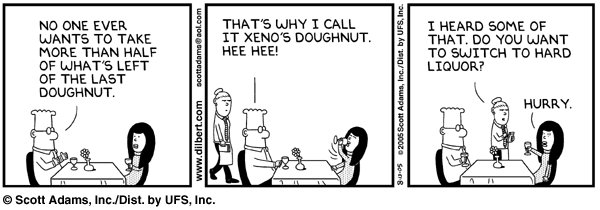
Xeno's Doughnut


Xeno's Doughnut* Posted by Picasa

I was going to write a little article about Xeno (sometimes spelled Zeno), but then I decided to simply include this link to a fun little page. On that page there are links to other articles about Xeno's paradoxes.

* Dilbert comic by Scott Adams, printed 08/15/05. I hope I don't get in trouble for this ...

Monday, August 08, 2005

My atheist philosophy overview

This is a continuation of a conversation begun on Mayfly's blog. Click here. Mayfly began by asking if there was something inherent about matter that drives it toward life and complexity.

This post has been bubbling about in my little brain for two weeks now. Tonight everything is frothing forth.

Q,

Let me preface this by saying that I respect your right to believe what you wish concerning these matters. I know firsthand how difficult and depressing it can be to have your entire world-view turned upside down. Like you, and Mayfly, and Arglor, I take no pleasure in undermining anyone's beliefs.

I do take pleasure in intelligent discussion and debate, and I think you do the same. I think we both value truth, even though we disagree about what is true. So I appreciate the courage you exibit in just listening to what I and others have to say, and I hope you realize it takes courage for me to lay bare my beliefs and have them openly criticized. I think that you, I, Arglor, Mayfly, and everyone that has taken part in this discussion has shown that courage.

In short, I think we are all commendable for trying to understand one another. I firmly believe that understanding must come before constructive dialogue.

Now, on to the substance. I think I understand where the miscommunication is this time. I will strive to make my points with concrete examples from now on, wherever I am able. And I will avoid all talk of turtles. ;-)

Q wrote: God is perfectly sufficient to explain the existence of the kind of complexity we have been discussing since Mayfly's original post.

You are quite right, God is sufficient to explain all kinds of instances of complexity. God can string nucleotides together all millenium long without batting an eyelash, more easily than I can assemble a child's bicycle. In this sense, you are absolutely correct.

Consider the implications of what are we saying, however, when we assert that because we don't know how something has happened, God must be responsible for it. No one was there to see how the amino acids and nucleotides formed. I don't know and you don't know; we don't know if God did it or not. One day we may figure it out, or we may never know. It doesn't follow from our lack of understanding that God had to have done it.

Suppose we can be sure that supernatural forces caused the amino acids and nucleotides to come together a certain way. If the transcendant realm does not usually interact with ours, then how do these forces cross over from that transcendant realm into our material realm, in order to coerce or manipulate matter into forms it can't (by hypothesis) take on in nature? We could assume these forces are from God, but how do we know? Are there many such transcendant realms, with other transcendant entities (angels or demons perhaps)? How do they exist? Of what do they consist? Does the transcendant realm follow laws, as our material realm seems to do? In the material world, we have noticed a marked correspondence between brain activity and human thought; is there some kind of activity in the transcendant realm that corresponds to the thoughts of transcendant beings? Do such beings even have thoughts?

There's no end to the questions we can ask about such a transcendant realm and the transcendant being/s that occupy it, and how they supposedly interact with us in the material realm. Following this train of thought, you can see that we have to introduce a whole new order of complexity, in the form of a transcendant realm and transcedant being/s, to explain just one perplexing instance of complexity, namely the formation of nucleotides and amino acid chains. Moreover, we have no good evidence for such a realm, other than the fact that we have an unexplained problem in evolutionary biology/chemistry.

On the other hand, we can investigate other options - matter and forces, physics and chemistry, things we do have some hope of understanding, because they are made up of much the same stuff as we are. We already have evidence, in the form of hundreds of years of scientific observation, hypotheses, repeated testing, and valid predictions, supporting our notions that they exist.

Q wrote: I'm building a list of challenges to a purely materialistic view of the universe:
(1) Where did matter/energy come from; or, if it is supposed to be eternal, how does that correspond to what we can observe about the universe?
(2) How did inanimate matter become living matter?
(3) How did human beings make the leap to consciousness?
(4) How do atheists adequately account for meaning and morality?


To your point 1: my understanding is that energy and matter are interchangeable and indestructible, the 2nd law notwithstanding. The 2nd law indicates that eventually no energy will be usable for work. It looks bleak, depressing even - but that doesn't mean it's not true. If it helps, there is hope in a theory according to which, as the universe expands, the unusable heat energy rarifies to a certain point, stretching space itself to the tearing point, which somehow causes another big bang (I don't know how it supposedly works). But even if this is true, the human race as we know it will be long gone. The way I see it, humanity is ignorant of many things and the future of the universe is uncertain. Personally, I like to think that our universe is one of many, but I don't think anyone knows.

To your point 2: Following fundamental, universal laws governing matter and energy, matter was arranged in complex forms, eventually culminating in life. We can observe the same kinds of reactions going on today, as the Urey-Miller experiment and other experiments show. We don't have to know every single detail and step in the process to come to this conclusion.

point 3 - I believe that over millions of years life evolved to the point of consciousness. I observe behavior in humans and other animals that indicates consciousness not unlike my own, and generally speaking the more sophisticated an animal's nervous system, the more conscious they seem to me. A plant is not conscious at all, a worm reacts to stimulii, a dog can be friendly or mean. I believe that consciousness is the product of complex biochemical and bioelectrical activity, and I believe that consciousness stops when that activity stops.

point 4 - I think that there is a rational basis for morality. I think morality arises as a consequence of physical, conscious, rational (or at least semi-rational) agents being in relationship and being able to affect one another. I believe morality is objective, not subjective, because moral rules are independant of what any moral agent or group of moral agents think or believe (even the postulated entity known as God). Morality is a consequence of what and who we are; it is not a decision made by us, and it does not issue from a higher power or plane of existence.

I think ethics stems from human nature, not God's nature. I cannot emphasize enough that this does not mean that morality is arbitrary or subjective. It means that morality is dictated by states-of-affairs in the real, physical world, and as such is flexible. What I mean by this, by way of example, is that killing is wrong when it's murder, but it's all right in self-defense. If we humans had natural body armor, it might be morally acceptable to go around hitting each other hard with baseball bats, but we're not, so it's not. It is a real, objective fact that all of our actions have consequences, and some of the consequences are good and some of them bad. Good is to be embraced and encouraged, and bad or evil is to be avoided and discouraged.

Even if God exists, I would believe the same things about ethics. I think God would abide by moral rules for the same reasons that we human beings should abide by them - because they are good. I believe that goodness is it's own reward, I don't believe that we should be threatened or cajoled by false promises into doing it.

Goodness is not God. Goodness is an abstraction, no matter how it exists, not a person. Good is good because it is beneficial to someone. Evil is evil because it harms someone, not because God arbitrarily dictates certain activities off-limits.

We all have a choice to live selfishly or to live selflessly. Most people strike a balance between the two, and I think that's good and appropriate.

Q wrote: I understand your position to be, "human existence is meaningful because humans exist."

I don't think mere existence is enough to create meaning. I think that we are able to assign meanings to things, like this string of letters that you are reading, because of our intellectual capacity to reflect on ideas and communicate. Not unlike morality, "meanings" come about by virtue of the relationships between things. Our ancestors survived by seeing relationships between things, and we instinctively look for new ways of understanding, new relationships.

Whereas I am saying that God, who transcends the material universe, and who is the source of human beings and everything else that exists — that this God validates human existence. Why doesn't God need another [validation of] her existence? Because God is existence. Whereas this material universe cannot be equated with existence. Once, it did not exist. Eventually it will once again cease to exist; or at least, all living beings will cease to exist.

In my view, validation is completely irrelevant. I know I exist - I have no good evidence that God exists, but I do have evidence that God does not exist. My own existence is a brute fact, one I cannot ignore. To me, the evidence is quite clear. I am a highly complex being, made up of constituent parts. The universe operates according to laws that humans are able to discover, and my existence is in virtue of these things that make up my body, which is me. When my body is gone, I will be gone too.

When you say that God is existence, then I must reply that when you assert that God exists, it seems to me that you are saying Existence exists. Being the totality of all that exists, God must include evil and tragedy and pain just as much as it includes good and hope and all things pleasant.

Just a few of the many reasons that people will not want to accept what I have outlined here are: 1) it means we are mortal, 2) it means our loved ones who have passed away are truly gone, 3) it means that our actions have real, irrevocable consequences 4) it means that humans are animals.

I am under no illusions that anyone will be convinced by this - I fully expect disagreement. It is my hope that by posting this I will further understanding and dialogue, and foster tolerance.

I hope this clears the air somewhat. No longer can I be accused of merely hinting around at my philosophical position. There is material here (no pun intended) for many a lengthy dialogue to come. Or, it could be the case that my theistic friends will avoid discussing these things with me from now on. If so, I understand and respect that, too.

Sunday, July 24, 2005

memes and a breather

This is meant to be a "light" post - a break from the fairly serious and lengthy discussions instigated by the previous two.

First, a personal note: the last couple of posts led to discussions which were strangely intense for me, so I have taken a break from blogging the last few days.

After a lifetime of searching and countless hours in and out of the classroom studying philosophy and religion, I thought myself capable of a little more detachment than I demonstrated in the last thread. I've become acutely conscious of some insecurities I have regarding my atheism. Now that I have learned a lesson in self-control, I am eager to continue the discourse and work through these things. I think and hope that others have also found the conversation fruitful, in different ways.

I would like to thank everyone for keeping the discussion polite and reasoned and, more importantly, for showing concern for each other. I am proud to find myself among upstanding people and I'm sure we will have more to talk about soon. There were a lot of subjects raised, and I have yet to decide how best to follow up.

In the meantime - so as not to break from the subject of religion, but not to get too entrenched in formal argumentation just now, either - I want opinions on a new belief system I discovered on the web today called The Church of Virus.

This belief system is self-described as an "atheistic religion," which to me sounds like a self-contradiction. They believe in memetics* (although I don't know whether they represent it accurately), and that their belief system leads to a meaningful life and immortality, among other things.

I am extremely skeptical of memetics, and I am even more skeptical of this new religion. What do you guys think?

* Memetics is the study of memes and their social effects. A meme is a unit of cultural information, such as a cultural practice or idea, that is transmitted verbally or by repeated action from one mind to another. Memes purportedly "compete" for survival in the environment of minds and cultures just as organisms "compete" for survival in the physical environment of the world.

Sunday, July 17, 2005

Divine Command Theory and the Euthyphro Argument

I promised to do a post on the Euthyphro Argument, and here it is. I know it's been a long time coming. I had to postpone it a little bit on account of a Major Event (ME). I will post about ME soon. As usual, all polite, thoughtful comments are welcome. Enjoy!

Portions of the material I am using here are taken from my notes from a lecture given in 2002 by Dr. Keith Allen Korcz at the University of Louisiana at Lafayette, for a philosophy course entitled 'Contemporary Moral Dilemmas.' Korcz has a talent for presenting arguments so simply, even I can understand them. This argument is widely known to theologians and philosophers of religion. You read the argument and judge whether it makes sense to you.

Divine Command Theory, or DC, is one way to see a relationship between ethics and religion. There are many varieties of DC, which claims that:

  1. What makes an action morally right, wrong, or neutral is God's command; and
  2. In order to determine what is right/wrong/neutral, we must determine what it is that God has commanded.
Different versions of DC can be formulated by substituting different definitions of God and selecting different means by which God makes commands known. According to classical theism, God is a supreme being who is omniscient, omnipotent, and omnibeneficent; and God's commands are revealed through select spokespersons and writings.

Notice that in order to determine what is right, wrong, or neutral, we must determine what God has commanded.

Notice also that any DC assumes the existence of God. This is not an argument about the existence of God, but about a relationship that is said to exist between God and morality.

Keeping that in mind, an argument for claim 1 above is:
  1. God exists
  2. If God exists, then he created morality.
  3. If God created morality, then God's commands made actions morally right, wrong, or neutral.
  4. Conclusion: God's commands made actions morally right, wrong, or neutral.
If we assume that 3, 4, and 5 are true, then 6 must be true. 3, although it is the subject of controversy, is assumed for the sake of the argument. 5 seems uncontroversial. It's not so clear that 4 is true. If 4 should turn out to be false, then the argument would be unsound.

The Euthyphro argument is aimed at premise 4.

THE EUTHYPHRO ARGUMENT: What does it mean to say that God's commands are good?

The Euthyphro argument is named after Plato's Euthyphro, in which Socrates poses the question, "Is the pious loved by the gods because it is pious, or is it pious because it is loved?" (10a). The Euthyphro Argument rests on a modernized version of the same question: "Does God command certain actions because he knows what makes actions morally right, wrong, or neutral; or, are actions morally right, wrong, or neutral because God commands them?

If the former case is correct, and God knows/sees/understands that certain actions have moral status (examples - killing is bad, stealing is bad, giving to worthwhile charities is good) then those acts have that moral status regardless of what God commands. Then divine command theory would be wrong because morality would not depend on God's commands.

If the latter case is correct, and God creates morality by commanding things, then anything he could command would be as good as anything else. There would be no moral reason to command one thing rather than another; morality would be arbitrary.

The problem for proponents of DC is that morality does not seem to be arbitrary. If actions were morally good because God commanded them, then God could have commanded that we hate our neighbor, and that we kill innocent people; and those actions would then be morally obligatory. But it seems as though killing innocent people would be wrong, even if God commanded it.

Moreover, it would trivialize the idea of God's goodness. Believers want to say that God's goodness is part of what makes God worthy of worship. If actions are good by virtue of God's will, then "God wills what is good" is equivalent to "God wills what God wills," and the latter statement doesn't seem to make God worthy of worship.

When I saw this argument for the first time as a sophomore in college, I was stunned. I had been firmly of the belief that morality did depend on God's commands! Eventually I accepted the point of the argument.

Friday, July 08, 2005

minority me

Found some cartoons today:


(That's the problem, sir ...)


(I want to join this guy's church!)


This last cartoon offends me.

Most of my life I have not been an atheist.

Although I no longer hold any scripture divinely inspired, my love for many writings remains undiminished. I recognize that holy scriptures represent some of the best and noblest characteristics possessed by human beings. Here is an excerpt from Ecclesiastes, chapter nine, which I find to be particularly wise and poignant.

For to him that is joined to all the living there is hope,
for a living dog is better than a dead lion.

For the living know they shall die,
but the dead know not any thing,
neither have they any more a reward,
for the memory of them is forgotten.
Also their love,
and their hatred,
and their envy,
is now perished;
neither have they any more a portion for ever
in any thing that is done under the sun.

Go thy way, eat thy bread with joy,
and drink thy wine with a merry heart;
for God now accepteth thy works.
Let thy garments be always white,
and let thy head lack no ointment,
Live joyfully with the wife whom whou lovest
all the days of the life of thy vanity,
which he hath given thee under the sun,
all the days of thy vanity;
for that is thy portion of this life,
and in thy labour
which thou takest under the sun.

Whatsoever thy hand findeth to do,
do it with thy might;
for there is no work, nor device,
nor knowledge, nor wisdom,
in the grave, whither thou goest.

I returned, and saw under the sun
that the race is not to the swift,
nor the battle to the strong,
neither yet bread to the wise,
nor yet riches to men of understanding,
not yet favour to men of skill;
but time and chance happeneth to them all.


Not the best translation, I'm sure, but there's none so poetic as the King James.

This passage is one of many that are particularly prescious to me. Were I to live a million years, I would never want to destroy the Bible (or any other scripture).

Wednesday, June 15, 2005

The Path of Philosophy

So, Grasshopper, you have chosen to walk the Path of Philosophy. You will find it here.

Good luck on your journey.

(This was so good, I had to post it here.)

Tuesday, April 26, 2005

determinism and ethics - a family portrait

A previous post has the title 'Moral Relativism?' and the subsequent discussion had very little to do with moral relativism. It had everything to do with the philosophical quandary surrounding the concepts of determinism and free will.

This post will also have nothing to do with moral relativism.

I have been working on the problem lately and I think I might see the outline of a kind of solution.

here are some notes on the fly ...

(A) Suppose that determinism is true, and that our actions are governed by factors that are, in principle, completely predictable. Free will is an illusion brought about by the fact that it is beyond our abilities to account for all the factors at once.

(B) Suppose that it is also true that we make choices and that we can be rightly held morally responsible for our actions.

How is (A) reconcilable with (B)?

evolution
survival
predicting the future/induction increases survival chances
imagination increases survival chances

faculties of imagination and prediction applied to human behavior causes the illusion that we could have chosen otherwise than we did

moral responsibility comes from the notion we could have done otherwise

the knowledge that there is a chance we can be held morally responsible affects our actions and increases our survival rate, as a species

evolution, survival, faculty of imagination & prediction, all are caused by deterministic(? - for lack of a better term at the moment) processes

the feeling of freedom is reducible to the ability to imagine and predict - we imagine that we could have done otherwise, and we predict what would happen in a similar situation if we behave differently. Predictions become causes of future behavior. Our ability to imagine many different outcomes is one reason our behavior is so difficult to predict - each imagined course of action and its probable outcome are weighed

Conclusion: the ability to make choices is the result of deterministic processes

Imagination and prediction, presumably the output of deterministic processes --> this output in turn is a causal factor in future behavior. This leads to the FAULTY impression that we could have chosen to do other than we did. Nevertheless it is important not to lose the motivational impetus that holding each other morally responsible provides ... because we would be removing one of the causes of future good actions ... we can imagine and predict that evil would result.

PROBLEM: Assumes that all the processes involved are deterministic ones.

PROBLEM 2: Just because the processes leading to the ability to make choices are all deterministic, doesn't necessarily mean that choice-making itself is deterministic

This is so sloppy I know. I have never been so careless before. But I have one more final paper to write and then finals to study for and I decided just to get this out there to see what you think.

I'll most likely delete this in the morning.

Ha ha. Ever seen the Princess Bride? "All right Westley, good job, good night, I'll most likely kill you in the morning ..."

Saturday, April 23, 2005

Moral relativism?

So yesterday afternoon I found myself very nearly defending a form of moral relativism, which discomfited me, since I do not believe in moral relativism. This bothered me so much that I checked out The Stanford Encyclopedia of Philosophy's entry on moral relativism*, just to brush up on it. Let me explain how I ended up in this predicament, at least as far as I can recall while still keeping this entry brief.

It began as a discussion of free will. The problem of free will is that it seems that we make choices, and that it is possible that we could have chosen to do other than what we did (this last is debatable) - but it also seems that minds are physical, and that physical things obey uniform natural laws which are determined and predictable. So, do our minds obey predictable laws or not?

Morality comes in because it seems that if we do not have free will, then we are not free to choose to do otherwise than we did. But our conception of moral responsibility hinges on the fact that we could have chosen to do other than we did.

Most philosophers want to preserve our concept of moral responsibility, because there doesn't seem to be any way to build up a workable ethics without it.

I have a problem in that the determinist position makes the most sense to me, but I believe in moral responsibility. So, I was trying to figure out a way of understanding the two concepts such that they are compatible.

What I came up with - and this is only the barest sketch of a theory - is that the utility of moral responsibility arises out of the fact that even though our behavior is determined in principle, we do not have an understanding of everything that determines our behavior. In order to develop this thought properly, I would have to write a lot more than I want to do here.

There is a whole can of worms here, so many that now that I have got to this point I don't know where to go. How did I get to the point of defending moral relativism? I forget. The conversation went in many directions and my thoughts right now are going in many directions.

Here's the thing: there is abundant evidence that our actions are determined. When we make choices, we usually have reasons. When we humans communicate with each other, we often try to convince each other to choose something or another, by offering reasons. Aren't our choices determined by reasons? If reasons do not determine our choices, then why would we try to convince each other of things?

Some choices may not be governed by reasons (at least conscious ones). Suppose I sometimes prefer cereal for breakfast, sometimes fruit. I may not have any good (rational) reason for choosing one over the other; the choice is purely based on my preference at the time. In this case, isn't the choice a result of my state of mind - which is a brain state - which is just chemistry and electricity and other physically determined events going on?

Wilbur pointed out that when we speak, each word we utter narrows the possiblities for what the next word will be. (Even gibberish follows a pattern.) When we listen to someone else speak, we often mentally fill in the ends of sentences before we hear them. If we can predict what someone is about to say with good accuracy, and we can sometimes know how others will react in a situation, then why would we think that this could not be refined and better understood to the point that we could completely predict what someone will do under any circumstances at all?

If we could do that, then we could say that the person's actions are determined. But the person would still make choices - it's just that we would know what the person would choose, before the person chose. Even though the choices were determined, it seems like the person is still morally reponsible for the actions he or she performs.

I have played fast and loose here and I don't know if I have expressed the issues very clearly, but I think free will and determinism are actually compatible, and that ethics need not be sacrificed.

Maybe Arglor will remind me how it came about that I said, "There's nothing self-contradictory about the term 'moral relativism'."

* For those of you who actually attempt a full read of the article, my hat's off to you. I think DMR is plausible for ordinary conversation but I don't really believe it. MMR is right out as far as I am concerned.

Saturday, April 09, 2005

Speak now or forever hold your peace.

I got the rough draft of my paper back from Dr. Korcz.

I believed my argument against the existence of possible worlds other than our own was brilliant, but I now see that my argument needs quite a bit of refinement.

This is going to require a lot of thought. But I'm not giving up; this do I solemnly swear by all I hold dear ...

KHAAAAAAAAAAAAAAAAAAAAAAAAAAAAAAAAAAAAAAANN!!!!*

I will strike, I will jab. I will flay about with razor logic until all possibilities are exhausted - no superficial subjunctives shall stand! I shall remain sillily triumphant in my own mind!!!!**

If you want to speak up for the existence of possible worlds, now's the time ... before I demonstrate once and for all the awesome power of a determined mind and lay waste to all that is not actual (in the non-indexical sense***)!!!!!!!!!****

*Thanks Arglor for the recent post.
** Unless I become convinced that the antithesis of the case contraindicated by the one I propose is correct, is correct.
*** David lewis maintains that actuality is whatever goes on here - no matter which possible world you happen to be in.
**** Emphatic, aren't I?

Tuesday, April 05, 2005

Intelligent design?


This says it all. By Tom Toles. Here is a link: intelligent design cartoon;Posted by Hello

By the way, I noticed that the a-words are now about trains. I can't wait to see what comes up next. I'll have to think of some interesting things to write about, and see how they respond. This could get fun!

Has anyone else noticed that the a-words change in the comment windows? I bet if you're creative with your comments you can get some interesting results. (I guess I'm asking Arglor since no one else reads this. Or if they do, they are very quiet.)

Come on snaars fans! Tell me what you really think about this cartoon!