Well, well, well ... bet you were never expecting to hear from me again! Yes, it's been over a week since I've posted. Sorry, snaars fans ... but you all wouldn't adore me half so much if I didn't live up to my obligations such as family, work, and school, now would you?
Yesterday I completed the report for my communication class. This is the one in which I was expected to answer the question, "Is democracy in a foreign country worth fighting for?" The question refers to Iraq, since the overarching question we as a class have been trying to answer is, "Is the Iraq war justified?" So, I interpreted the question as meaning, "Is democracy in Iraq worth fighting for?" Nevertheless I tried to discuss the larger theme of global democratization in the paper.
In the first part of my paper I argue that yes, democratic ideals are definitely worth fighting for. I point out that many people have fought and died to protect these ideals, and that we should be grateful. Our founding documents and our laws express the sentiment that democratic freedoms are intrinsically valuable. We believe they allow the greatest number of people to have the opportunity to lead the fullest possible lives.
Then I point out that just because something is worth fighting for, that doesn't mean we should fight for it in any and every situation. There are other means to get the results we want; war should be the absolute last resort.
In my paper I looked at a few reasons that President Bush offered in a speech in 2003, explaining his reasoning behind deposing Saddam and promoting democracy in Iraq. He gave three main reasons: 1) democratic ideals promote peace and stability, 2)success in Iraq will eventually result in peace throughout the Middle East, especially between Israel and the envisioned Palestinian state, and 3)deposing Saddam is a blow to terrorism. I argue against all three points.
My responses, very briefly:
1) Democratization is not well understood, and there is evidence showing that stability and prosperity facilitate democracy, not the other way around.
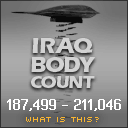
2)Iraq is in some ways less stable today than it was before Saddam was deposed. The U.S. administration refuses to estimate how many Iraqi civilians have been killed since military operations began. Estimates by other sources range, but the best conservative estimate is around 20,000 deaths that have occurred over and above what would have occurred had Saddam stayed in power. The real toll could be well over 100,000. These figures do not even consider people that have been wounded and maimed, only those killed. Furthermore, corruption is rampant in the new government. In one case alone, contractor Custer Battles defrauded the U.S. of $50 million of reconstruction money. Whistleblowers wanted to sue, but the Bush administration refused to back up the lawsuit.
3) Deposing Saddam has not been a blow to terrorism. U.S. intelligence has not shown any link between Saddam and Al Qaida, or 9/11. On the other hand, Iraq seems to have become a rallying cry for terrorists, since it is claimed that our actions there are proof of our imperialism. Our troops and Iraqi police and officials are attacked by insurgents on a daily basis.
Iraq is not yet a stable democracy. Elections were held, but under the heavy shadow of the U.S. presence there. Iraq will not be a true beacon of democracy until the U.S. can withdraw and leave a stable government in its wake. It does not seem that this can happen in the very near future.
The National Priorities Project has estimated the cost for Americans of the war in Iraq has been 183.8 BILLION dollars and climbing by thousands of dollars every second.
In conclusion, I state that although democratic ideals are worth fighting for, sometimes those same ideals would seem to indicate that it is sometimes better not to fight; rather we should pursue our goals by peaceful means.
Showing posts with label Iraq. Show all posts
Showing posts with label Iraq. Show all posts
Tuesday, April 19, 2005

Friday, March 04, 2005
They nearly lynched me.
Here's my letter to the class. When I wrote it I knew it would cause mixed feelings but I really didn't care. Since then we had a class discussion about it and I think we are all okay.
Open Letter to CMCN 304 class
If you don’t have the patience to read this entire e-mail, please skip to the last paragraph because I spoke to our instructor about something and you all need to know what she said.
When I read all the notes on our first presentation topic I became alarmed. During the quiz I could barely hold back my frustration. I find I must speak out for my own peace of mind.
Let me try to explain why. It is NOT because I have any special knowledge about the war. I have tried to follow events in the news on a daily basis. Anything I have read about it comes from the mainstream press. I try to read from a variety of sources and political leanings, so that I can form an intelligent and balanced opinion. If anything sets me apart it is that as a philosophy major I have learned to think critically about a variety of issues, to identify good and bad reasoning, and to evaluate evidence.
I was disappointed by the presentation notes because the evidence presented just did not support the conclusions offered. The notes were full of bad reasoning, insufficient evidence, untrue assertions, and questionable assumptions. I will cite examples of what I’m talking about.
President Bush’s inaugural speech is not good evidence. President Bush is in the position of having to justify his decision to go to war. He is not an unbiased source. We need unbiased information if we want to find out if the reasons offered are good ones. Likewise for any of the other architects of the war. In case you think I’m coming down on one side or the other, I’ll say this: Kerry’s speech didn’t count either. He was running against Bush at the time. Generally speaking, political speeches of any kind are not trustworthy sources of information. No one presented in the notes any connection between the events of 9/11 and Saddam Hussein. As far as I know there is none. The administration has been very careful in the way they talk about this. They often mentioned 9/11 in the same breath with Saddam Hussein, implying that there is some connection. But the only connection I know of is that 9/11 was an act of terrorism and Saddam Hussein is also labeled as a terrorist. No evidence has surfaced that Saddam was in any way involved with 9/11. Homeland security was being implemented before we went to war with Iraq – it’s not a result of the war. So, anything in the presentations about homeland security was beside the point. The question was “Is America more secure as a result of the war in Iraq.” There were no weapons of mass destruction, and Saddam was not capable of producing any. Iraq was not a danger to the US. The intelligence the administration relied on in making its decision was flawed. They have admitted that. (No one included the admission in their presentation notes.) So, either the administration made a mistake in trusting the info, or they went ahead knowing the info was flawed. Which is worse? (There were a lot of people speaking up at the time saying that the info was flawed, but the admin refused to pay attention.) What the weapons inspectors found was that Saddam was doing his best to maintain his ability to resume production. Any other country on the earth would want to do the same under those circumstances. Iraq still needed to defend itself from its neighbors. Saddam was deceiving the inspectors to keep the neighboring countries guessing about Iraq’s capabilities. He was bluffing. We are trying to eliminate terrorism – the Iraq war has been a boon to terrorism. Yes, Saddam was a brutal dictator. But there was not rampant terrorism under his regime. Now Iraq is the world’s leading breeding ground of terrorists. Iraq has become a terrorism magnet and no doubt new alliances are being forged daily. No one mentioned this in their notes. Someone has to explain how war overseas prevents terrorism here in America, considering most of the 9/11 terrorists were Syrian and none of them (I think) came from Iraq. I suppose people think it’s all the same because all of these countries are “in the mideast” and they’re all “arabs” so they’re all the same. If anything has prevented terrorism here it is our homeland security efforts, not the war. Creating mideast democracies – the idea is that if those countries are democratic, the people would like us better. This is a questionable assumption. Even if it’s true, is that a reason to go to war? Should we go to war with every undemocratic nation?
I’m not even going to start in on the idea that the war is good for the Iraqis, since that has not come up yet in class. Likewise with the funding issues.
Obviously I am not grading the class and I cannot tell anyone what to do. The purpose of this e-mail is just to encourage everyone to take this project seriously and to make a decent attempt to look at more than one side. Like most of you, I do not have hours upon hours to devote to research for this class. I work a full-time job, I have a full-time course load, and I am a full-time husband and parent. But I take all my classes seriously. I am 31 years old and working toward my first degree and I am not here to fool around.
Everyone in the class knows someone who knows someone who is fighting today in Iraq. How deeply are we going to look at this issue? There are serious objections to the war in Iraq. Hopefully I have given you some idea of what those objections are based on. I believe we owe it to our fellow Americans serving overseas to try to understand these issues, no matter what side of the issue we choose to be on in the end. Good people are dying every day. As voting Americans we have a duty to make sure that our leaders are doing the right thing, and to hold them accountable if they have not done the right thing.
I hope I have expressed myself without offending anyone. I am open to differences of opinion and I am not trying to attack anyone personally.
On a side note – this has nothing to do with what I have written so far: After class last night I approached our instructor and asked her about the research guidelines for the class. In a previous class she had stated that our research should be scholarly. I asked her if that was still true, and she said that it was. The reason I asked her is that in most of the notes there was no indication whatsoever what the sources were. It is not required that we share our sources with each other, but it will probably help us get a good grade if we let each other know when we’ve found a valuable source of information.
Open Letter to CMCN 304 class
If you don’t have the patience to read this entire e-mail, please skip to the last paragraph because I spoke to our instructor about something and you all need to know what she said.
When I read all the notes on our first presentation topic I became alarmed. During the quiz I could barely hold back my frustration. I find I must speak out for my own peace of mind.
Let me try to explain why. It is NOT because I have any special knowledge about the war. I have tried to follow events in the news on a daily basis. Anything I have read about it comes from the mainstream press. I try to read from a variety of sources and political leanings, so that I can form an intelligent and balanced opinion. If anything sets me apart it is that as a philosophy major I have learned to think critically about a variety of issues, to identify good and bad reasoning, and to evaluate evidence.
I was disappointed by the presentation notes because the evidence presented just did not support the conclusions offered. The notes were full of bad reasoning, insufficient evidence, untrue assertions, and questionable assumptions. I will cite examples of what I’m talking about.
I’m not even going to start in on the idea that the war is good for the Iraqis, since that has not come up yet in class. Likewise with the funding issues.
Obviously I am not grading the class and I cannot tell anyone what to do. The purpose of this e-mail is just to encourage everyone to take this project seriously and to make a decent attempt to look at more than one side. Like most of you, I do not have hours upon hours to devote to research for this class. I work a full-time job, I have a full-time course load, and I am a full-time husband and parent. But I take all my classes seriously. I am 31 years old and working toward my first degree and I am not here to fool around.
Everyone in the class knows someone who knows someone who is fighting today in Iraq. How deeply are we going to look at this issue? There are serious objections to the war in Iraq. Hopefully I have given you some idea of what those objections are based on. I believe we owe it to our fellow Americans serving overseas to try to understand these issues, no matter what side of the issue we choose to be on in the end. Good people are dying every day. As voting Americans we have a duty to make sure that our leaders are doing the right thing, and to hold them accountable if they have not done the right thing.
I hope I have expressed myself without offending anyone. I am open to differences of opinion and I am not trying to attack anyone personally.
On a side note – this has nothing to do with what I have written so far: After class last night I approached our instructor and asked her about the research guidelines for the class. In a previous class she had stated that our research should be scholarly. I asked her if that was still true, and she said that it was. The reason I asked her is that in most of the notes there was no indication whatsoever what the sources were. It is not required that we share our sources with each other, but it will probably help us get a good grade if we let each other know when we’ve found a valuable source of information.
Thursday, March 03, 2005
Last Monday night's communication class was very intense because of an e-mail I sent to my classmates. The class is called "group communication and problem solving". We have a project, which is to answer the controversial question, "Is the war in Iraq justified?"
The topic was chosen through a group brainstorming and elimination process. We were instructed to choose a controversial topic question. This is so that we have to overcome obstacles to communication in order to successfully complete the project. The way the project has been organized, each person is responsible for doing some research, communicating within their small group, and also communicating with the larger class as a whole.
We were further instructed to come up with five sub-topic questions, the answers to which would help us decide the answer to the main topic question. The subtopic questions are (let's see if I can remember them all):
I have a problem which is that my mind is in a whirlwind about what it would take to actually answer some of these questions - if answers are even humanly possible. This is of course the wrong attitude (for lack of a better word right now) for this class. The professor is certainly not worried about the answer - she is worried about whether we can overcome our political differences in order to work together. In general my classmates are not interested in doing a lot of research. They want to type in keywords and get easy answers from the internet.
I am incensed by the whole process. This is a very serious topic. What really gets me going is the total lack of critical thinking skills in the group. My classmates are getting their information and rationales from political speeches and interviews. They are using quotes from the administration without asking themselves if the reasoning makes sense (which it doesn't). Moreover, the hard evidence that was used was irrelevant, and yet it was presented as if it answered the question.
If these years of college have proved to me one thing, it is this: America's high schools are pursuing the wrong educational philosophy. I am a prime example. I thought I got a good education, and in some ways, that was true. But critical thinking skills were not a part of it. I had to come to college to get that. Everyone should get that in high school. There's too much emphasis on "the three R's". Everyone should have a handle on those by the fifth or sixth grade. After that, they should be trained to think for crying out loud.
Ah well, this has turned into a rant. See how easily I fall into that trap. I didn't even tell you about the e-mail I sent to all my classmates that got them all emotional. Maybe next time.
Now my picture isn't at the top anymore. See how I will inevitably and inexorably descend lower and lower.
The topic was chosen through a group brainstorming and elimination process. We were instructed to choose a controversial topic question. This is so that we have to overcome obstacles to communication in order to successfully complete the project. The way the project has been organized, each person is responsible for doing some research, communicating within their small group, and also communicating with the larger class as a whole.
We were further instructed to come up with five sub-topic questions, the answers to which would help us decide the answer to the main topic question. The subtopic questions are (let's see if I can remember them all):
- Is America more secure as a result of the war in Iraq?
- Is the administration providing good reason for the war?
- With the national debt increasing, can we afford the war?
- Are the Iraqis better off as a result of the war?
- Is democracy in a foreign country worth fighting for?
I have a problem which is that my mind is in a whirlwind about what it would take to actually answer some of these questions - if answers are even humanly possible. This is of course the wrong attitude (for lack of a better word right now) for this class. The professor is certainly not worried about the answer - she is worried about whether we can overcome our political differences in order to work together. In general my classmates are not interested in doing a lot of research. They want to type in keywords and get easy answers from the internet.
I am incensed by the whole process. This is a very serious topic. What really gets me going is the total lack of critical thinking skills in the group. My classmates are getting their information and rationales from political speeches and interviews. They are using quotes from the administration without asking themselves if the reasoning makes sense (which it doesn't). Moreover, the hard evidence that was used was irrelevant, and yet it was presented as if it answered the question.
If these years of college have proved to me one thing, it is this: America's high schools are pursuing the wrong educational philosophy. I am a prime example. I thought I got a good education, and in some ways, that was true. But critical thinking skills were not a part of it. I had to come to college to get that. Everyone should get that in high school. There's too much emphasis on "the three R's". Everyone should have a handle on those by the fifth or sixth grade. After that, they should be trained to think for crying out loud.
Ah well, this has turned into a rant. See how easily I fall into that trap. I didn't even tell you about the e-mail I sent to all my classmates that got them all emotional. Maybe next time.
Now my picture isn't at the top anymore. See how I will inevitably and inexorably descend lower and lower.
Friday, February 11, 2005
I ain't nothin' but a houn' dog
I read a lot of political stuff in the news. I have been more or less following national and international politics for five years. I still don't know what to make of it. Sometimes I want to give up trying to figure out what's really going on.
I want everyone to know that although I may express strong opinions on ethics and morals and such, I understand that these things have little to do with politics. Therefore, try not to take my political writing too seriously.
But please don't discount it either. In my conversations with co-workers, family, and friends, I have noticed that too many people have too much confidence in their own understanding and too much confidence in government. I know, I know, everyone professes to be very cynical about government these days, but let's face it. We say we don't trust our government, but we trust them with everything.
Time and time again I have had conversations in which I point out inconsistencies and hypocracy perpetrated by our own government, and the stock response I receive is, "Well, yes, that's true. But out government officials know more than we do. We don't know everything that goes on."
Why don't we know everything that goes on? Aren't we-- who live in the greatest representative republic in history-- aren't we supposed to know what is going on? Every nation has to have secrets - I'm not talking about things related to our national security or cloak-and-dagger stuff. I'm talking about what our own public officials are doing and their reasons for doing it, and how they are spending our money.
For example: when I point out to people that every rationale we have had for going to war with Iraq has been either 1) mistaken, or 2) a lie, hence the administration is either incompetent or untrustworthy, the reply I get is always something like, "That's not true - there's more going on than we know about. I'm sure there are actually good reasons for everything that happened."
I'm sure there are other reasons for the war. I just get the sense that if we good American subjects were aware of the reasons, we wouldn't like them. And that's why we have not been told what the real reasons are.
I want everyone to know that although I may express strong opinions on ethics and morals and such, I understand that these things have little to do with politics. Therefore, try not to take my political writing too seriously.
But please don't discount it either. In my conversations with co-workers, family, and friends, I have noticed that too many people have too much confidence in their own understanding and too much confidence in government. I know, I know, everyone professes to be very cynical about government these days, but let's face it. We say we don't trust our government, but we trust them with everything.
Time and time again I have had conversations in which I point out inconsistencies and hypocracy perpetrated by our own government, and the stock response I receive is, "Well, yes, that's true. But out government officials know more than we do. We don't know everything that goes on."
Why don't we know everything that goes on? Aren't we-- who live in the greatest representative republic in history-- aren't we supposed to know what is going on? Every nation has to have secrets - I'm not talking about things related to our national security or cloak-and-dagger stuff. I'm talking about what our own public officials are doing and their reasons for doing it, and how they are spending our money.
For example: when I point out to people that every rationale we have had for going to war with Iraq has been either 1) mistaken, or 2) a lie, hence the administration is either incompetent or untrustworthy, the reply I get is always something like, "That's not true - there's more going on than we know about. I'm sure there are actually good reasons for everything that happened."
I'm sure there are other reasons for the war. I just get the sense that if we good American subjects were aware of the reasons, we wouldn't like them. And that's why we have not been told what the real reasons are.
Thursday, February 10, 2005
retraction: FOX did not buy Al Jazeera
It was a satirical article. If I had seen it firsthand, it would have been obvious. But hearing about it second- or third-hand and having presented to me as factual I was almost taken in.
Iran, N.Korea, and nukes
Today North Korea announced that it has nuclear weapons. The U.S. is pursuing diplomatic relations with North Korea, even though we know they despise us to the core. This is because we know that as long as we keep paying Kim Jong Il, he will not nuke anyone.
Today the president of Iran, Mohammad Khatami, in a fiery speech to the Iranian people announced that for any invaders Iran would become a 'burning hell'. Iran has been cooperative and open up until this point, voluntarily suspending its uranium enrichment program. Iran needs the uranium for nuclear power, which is necessary for Iran's growing population. They have promised not to use the enriched uranium for nuclear weapons. Until now they have seemed open to diplomacy and cooperation. The U.S. administration has been making sounds of war though, and it seems the Iranians' patience is wearing thin. I can't say as I blame them.
We saw that the weapons inspections were actually working in Saddam's Iraq (even though Saddam had reason for wanting the world to think the inspections weren't working). How much better would they work in Iran? I don't know the anwer to this question, but my gut tells me they could work.
Why would we continue diplomatic relations with North Korea and not with Iran? North Korea has always been threatening and belligerent in its posturing, while Iran has been open to dialogue. We are rewarding the war-mongerers and punishing the cooperators. The only conclusion I can reach is that our administration is looking for any excuse to invade yet another middle eastern country in the name of 'spreading freedom and tolerance'.
'Spreading freedom and tolerance' = 'You do it our way or else'. This is truly Orwellian.
Today the president of Iran, Mohammad Khatami, in a fiery speech to the Iranian people announced that for any invaders Iran would become a 'burning hell'. Iran has been cooperative and open up until this point, voluntarily suspending its uranium enrichment program. Iran needs the uranium for nuclear power, which is necessary for Iran's growing population. They have promised not to use the enriched uranium for nuclear weapons. Until now they have seemed open to diplomacy and cooperation. The U.S. administration has been making sounds of war though, and it seems the Iranians' patience is wearing thin. I can't say as I blame them.
We saw that the weapons inspections were actually working in Saddam's Iraq (even though Saddam had reason for wanting the world to think the inspections weren't working). How much better would they work in Iran? I don't know the anwer to this question, but my gut tells me they could work.
Why would we continue diplomatic relations with North Korea and not with Iran? North Korea has always been threatening and belligerent in its posturing, while Iran has been open to dialogue. We are rewarding the war-mongerers and punishing the cooperators. The only conclusion I can reach is that our administration is looking for any excuse to invade yet another middle eastern country in the name of 'spreading freedom and tolerance'.
'Spreading freedom and tolerance' = 'You do it our way or else'. This is truly Orwellian.
Wednesday, February 09, 2005


Thursday, February 03, 2005
fun to shoot 'em
I heard a rumor today that FOX purchased Al Jazeera. My first reaction was to laugh, but it is not a joke. That is to say, it was not told to me as a joke. Whether it is true is another matter. I don't know what to make of it if it is true.
In other news (got this from Reuters):
In other news (got this from Reuters):
U.S. Marine Corps Lt. Gen. James Mattis, who led troops in Iraq and Afghanistan, made the [following] comments at a conference Tuesday in San Diego. "Actually it's quite fun to fight 'em, you know. It's a hell of a hoot. It's fun to shoot some people. I'll be right up front with you, I like brawling," said Mattis. "You go into Afghanistan, you got guys who slap women around for five years because they didn't wear a veil," Mattis said during a panel discussion. "You know, guys like that ain't got no manhood left anyway. So it's a hell of a lot of fun to shoot them."
Well, Mr. Mattis, this is a relief. So many women in abusive relationships will be thrilled to be informed of your ethical insights. I suppose now any good red-blooded blue-clad inner city cop is perfectly justified in walking down the street and shooting down anyone who looks like they might just possibly be a wife-beater. It will be easier for the police, of course, if the recipients of the bullets are different-looking, or immigrants from a foreign culture.
Monday, January 31, 2005
Iraq election
The newspapers are reporting that the voter turnout in Iraq was expected to be around 57%. Preliminary estimates of the actual vote are around 60%, so that is a little encouraging. Although there were a few Sunni-majority areas where the turnout was virtually nil, it seems that this was less because of the death threats and more because the religious leaders in those areas called for a boycott. (Or-- what is more likely the case now that I think about it-- those areas where folks received death threats may be the same areas in which the leaders oppose the vote?)
There were 9 suicide bombers. Reports I read were a little vague but it seems 35 people were killed altogether.
I still have my worries, but the vote gives me a little hope that something good can come from all of this violence and madness. It really says something about the people when they turn out despite everything. Twenty-two months of American occupation after Saddam's regime was toppled-- a feat the Iraqis had nothing to do with-- they finally get to do something for themselves. The New York Times had this quote today in an article about the elections: "The election was a victory of our own making," said Mr. Rubaie, the security adviser. "Today, the Iraqi people voted with their own blood."
There were 9 suicide bombers. Reports I read were a little vague but it seems 35 people were killed altogether.
I still have my worries, but the vote gives me a little hope that something good can come from all of this violence and madness. It really says something about the people when they turn out despite everything. Twenty-two months of American occupation after Saddam's regime was toppled-- a feat the Iraqis had nothing to do with-- they finally get to do something for themselves. The New York Times had this quote today in an article about the elections: "The election was a victory of our own making," said Mr. Rubaie, the security adviser. "Today, the Iraqi people voted with their own blood."
Saturday, January 29, 2005
elections
I am anxious about the elections in Iraq tomorrow. The whole situation is so ugly, I don't want to think about it, but it is more and more on my mind. I know it's going to be awful - more people will die, and voter turnout will be pitiful. Still, president bush will tout the day as being a great day for democracy and the Iraqi people. I won't go on and on about it, because I know everyone has their own opinion. I guess I just want to express my sadness over it all.
Subscribe to:
Posts (Atom)