Well, well, well ... bet you were never expecting to hear from me again! Yes, it's been over a week since I've posted. Sorry, snaars fans ... but you all wouldn't adore me half so much if I didn't live up to my obligations such as family, work, and school, now would you?
Yesterday I completed the report for my communication class. This is the one in which I was expected to answer the question, "Is democracy in a foreign country worth fighting for?" The question refers to Iraq, since the overarching question we as a class have been trying to answer is, "Is the Iraq war justified?" So, I interpreted the question as meaning, "Is democracy in Iraq worth fighting for?" Nevertheless I tried to discuss the larger theme of global democratization in the paper.
In the first part of my paper I argue that yes, democratic ideals are definitely worth fighting for. I point out that many people have fought and died to protect these ideals, and that we should be grateful. Our founding documents and our laws express the sentiment that democratic freedoms are intrinsically valuable. We believe they allow the greatest number of people to have the opportunity to lead the fullest possible lives.
Then I point out that just because something is worth fighting for, that doesn't mean we should fight for it in any and every situation. There are other means to get the results we want; war should be the absolute last resort.
In my paper I looked at a few reasons that President Bush offered in a speech in 2003, explaining his reasoning behind deposing Saddam and promoting democracy in Iraq. He gave three main reasons: 1) democratic ideals promote peace and stability, 2)success in Iraq will eventually result in peace throughout the Middle East, especially between Israel and the envisioned Palestinian state, and 3)deposing Saddam is a blow to terrorism. I argue against all three points.
My responses, very briefly:
1) Democratization is not well understood, and there is evidence showing that stability and prosperity facilitate democracy, not the other way around.
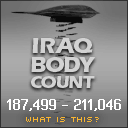
2)Iraq is in some ways less stable today than it was before Saddam was deposed. The U.S. administration refuses to estimate how many Iraqi civilians have been killed since military operations began. Estimates by other sources range, but the best conservative estimate is around 20,000 deaths that have occurred over and above what would have occurred had Saddam stayed in power. The real toll could be well over 100,000. These figures do not even consider people that have been wounded and maimed, only those killed. Furthermore, corruption is rampant in the new government. In one case alone, contractor Custer Battles defrauded the U.S. of $50 million of reconstruction money. Whistleblowers wanted to sue, but the Bush administration refused to back up the lawsuit.
3) Deposing Saddam has not been a blow to terrorism. U.S. intelligence has not shown any link between Saddam and Al Qaida, or 9/11. On the other hand, Iraq seems to have become a rallying cry for terrorists, since it is claimed that our actions there are proof of our imperialism. Our troops and Iraqi police and officials are attacked by insurgents on a daily basis.
Iraq is not yet a stable democracy. Elections were held, but under the heavy shadow of the U.S. presence there. Iraq will not be a true beacon of democracy until the U.S. can withdraw and leave a stable government in its wake. It does not seem that this can happen in the very near future.
The National Priorities Project has estimated the cost for Americans of the war in Iraq has been 183.8 BILLION dollars and climbing by thousands of dollars every second.
In conclusion, I state that although democratic ideals are worth fighting for, sometimes those same ideals would seem to indicate that it is sometimes better not to fight; rather we should pursue our goals by peaceful means.

Subscribe to:
Post Comments (Atom)




5 comments:
My reflexive response to your prof's question: (a) it is worth fighting to preserve democracy against a totalitarian invader; but (b) it is a dubious proposition that we can successfully impose democracy on unwilling subjects by going to war.
With respect to Iraq, in particular, I'm not sure how democracy can prosper if Iraqis perceive the USA as an occupying, colonial power.
I guess democracy was planted in India by a colonizing nation, but somehow I doubt that precedent is applicable. It certainly doesn't warrant a return to the "white man's burden" mindset.
Q
Great to here from you, Q! I joke about all my "fans" but in reality visitors here are rare. Most of those that view my site are personal friends and family. So I am pleased whenever a stranger drops in to give their opinion.
In response to your post:
The questions we were assigned in class made little sense to me. I was frustrated with the way they were phrased. The professor was not to blame though. The class is about small group dynamics. The idea is to get all the students working together on a controversial topic. At the beginning of the semester we went through a brainstorming process to come up with questions and then they were put to a vote.
The vast majority of the class are pro-Bush. That would not have bothered me so much if their views were well thought-out, but they weren't. At the risk of sounding arrogant, I hope I have taught them something about critical thinking.
The class has been very frustrating for me, but I have learned a lot about small group communication, which was the goal.
I wonder if good argumentation can persuade without utilizing rhetoric. I often wonder about this. Your argument seems valid and cogent, but i wonder how persuasive it is to the classroom of individuals who tend not to listen.
LOOK AT THAT! You got yourself a visitor that i've never seen before. Congrats, perhaps your google adware will become profitable.
What? Google adw- doh! I forgot!
Um, Q, you would probably find it very beneficial to click on whatever adware links you might happen to find in the left-hand column over there. I hear that they're context-sensetive, which means that bunches of time and expense have been utilized to bring you the advertisements that are most relevant. It would be silly NOT to click on them, when you thin-kabout it. ;-)
O ... M ... G!
Meet Iranian guys and girls? What will those google folks come up with next?
Post a Comment